
Dracyon considers the common weaknesses of air cannons, and explains how they can be overcome. Accepting widely held assumptions is a great hindrance to productivity. Breakthroughs often occur when assumptions are challenged. This is the case for air cannon technology. Many plants assume their air cannons are technologically advanced. The reality is that most air cannons were designed around the turn of the century and have experienced little progress since then. Not many people would consider a television designed in 2007 to be advanced.
A plant’s air cannons are also assumed to be effective. Yet most plants provide supplemental cleaning services, such as high-pressure water washing. If a lawn care service required regular supplementation, it would not be considered effective. A final assumption made is that air cannons are reliable. However, many air cannons are out of order and others require a steady stream of replacement parts. A car requiring the same amount of attention would not be driven. Dracyon challenged these assumptions and produced an air cannon that is truly advanced, effective, and reliable. This breakthrough enables plants to save money through reduced maintenance costs and increased productivity. Yesterday’s air cannon will not solve today’s challenges.
Advanced Technology
What makes a golf swing powerful? At first glance, some might say ‘arm strength’. Arm strength is important, but the torque generated by the midsection is far more important. Something similar has happened in the air cannon industry. When asked what the most important factor for air cannon cleaning is, many answer ‘peak force’. Like the golf swing analogy, peak force is important but another factor is far more important: momentum and kinetic energy.
The difference described above is crucial because it affects the design of air cannons. If peak force truly is the answer, the best air cannons will be determined by quick release valves. If momentum and kinetic energy are the answer, then the best air cannon will be defined by volume and nozzle design.
Volume
Volume is related to kinetic energy (KE=1/2mv2) and momentum (p=mv). When it comes to air cannons, the easiest way to increase volume is to increase the size of the reservoir tank. This is, perhaps, the most recognizable feature of Dracyon’s Big Blue air cannon. Many plants are supplied with 70 l or 150 l air cannons. By increasing the volume to 300 l, the Big Blue air cannon more than doubles and (nearly) triples the kinetic energy and momentum compared to its competitors. Without volume the cleaning area is limited.
Velocity
Velocity is also related to kinetic energy and momentum but with one important difference. Velocity is exponentially related to kinetic energy.
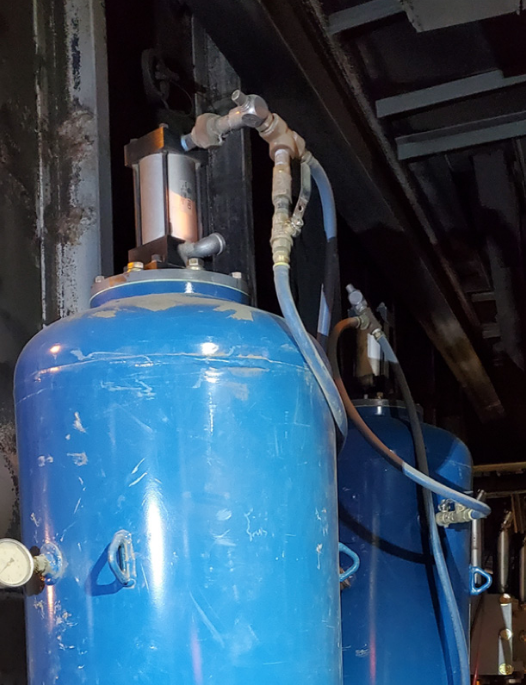
Figure 1. The Big Blue air cannon is noticeably larger than other designs.
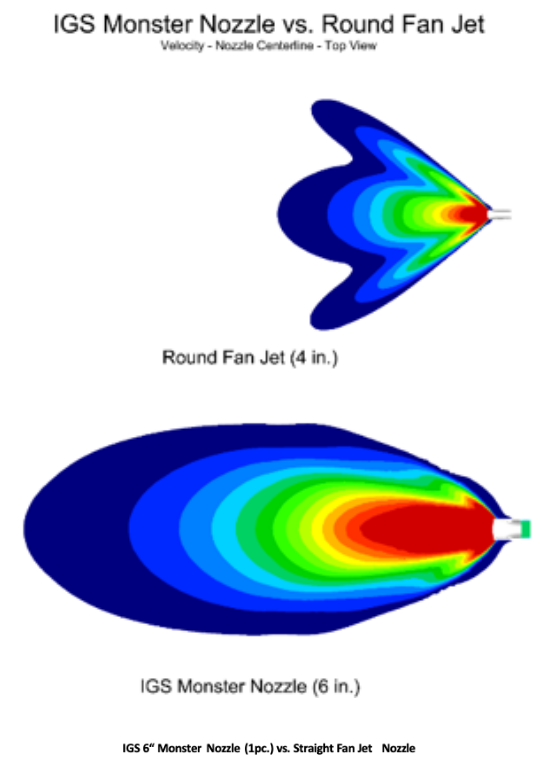
A doubling of velocity will yield a quadrupling of kinetic energy. The best way to increase velocity is through the design of the nozzle. Air cannons have typically employed a fan jet nozzle designed to produce a wide blast of air over the greatest possible surface area. What it gains in wide surface area, it sacrifices in velocity. A wide blast will accomplish nothing if it does not have the power to move the material. In today’s plants, cleaning only 1 m in front of an air cannon is not enough.
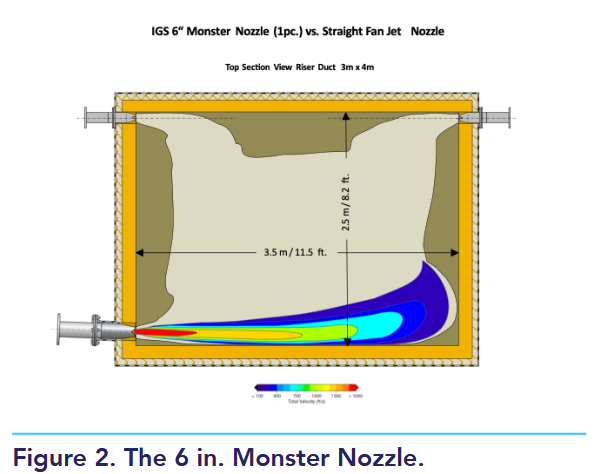
Instead of focusing on surface area, Dracyon’s nozzle is designed to move material. Firstly, it is larger (6 in. versus 4 in.). The larger nozzle generates more air (or volume), therefore, cleans at the time of discharge. Secondly, it increases velocity by choking the outlet opening. This is similar to using a thumb to increase velocity from the garden hose. The result of these design features is simple. A large volume of air is discharged with very high velocity. A nozzle, in other words, that moves material.
Conclusion
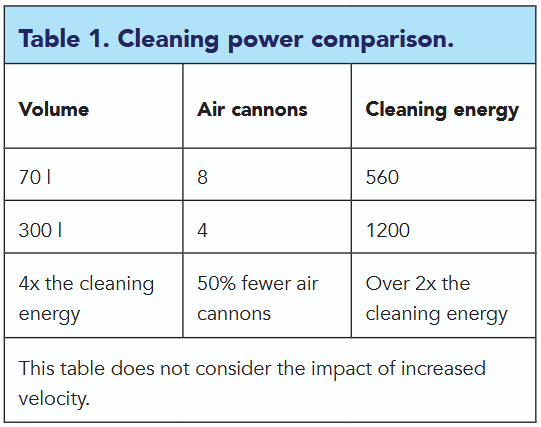
With greater kinetic energy and velocity, the Big Blue air cannon moves more material than other air cannons. Plants can generate more cleaning power with fewer air cannons, as Table 1 illustrates. This technological advancement is a direct result of challenging the prevailing assumption that peak force was the most important factor for air cannon cleaning.
Effective cleaning
Poorly designed air cannons are the inevitable consequence of having low expectations. Many plants still believe that their air cannons are effective despite the need for regular manual cleaning services. On the one hand, this is reasonable; it would be unfair to expect small air cannons with fan jet nozzles to not require additional manual cleaning. However, this does not have to be accepted as the standard; an effective air cannon should remove the need for manual cleaning. Moreover, it is important to note that manual cleaning is a safety risk.
Many of the problems associated with air cannon failure are entirely avoidable. They often stem from poor installation practices. The most common of which are:
- Installing the air cannon too close to the application. This practice is often related to the notion that peak force is the most important factor for cleaning (peak force is significantly reduced in long pipe runs). When air cannons are close to the application, they are exposed to the heat, which, in turn negatively affects the air cannon’s internals.
- Installing the air cannon at a negative angle. One of the most irresponsible practices is installing the air cannon facing upward (even slightly). That guarantees that the material from the process will eventually enter the air cannon and cause premature failure. This, too, is often associated with a desire to maintain peak force and avoid long pipe runs.
- Installing the air cannon in an inaccessible location. Air cannon maintenance often require slight adjustments that can be performed online. If the air cannon is inaccessible, however, maintenance cannot be performed, and cleaning is lost.
When air cannons do not work, buildup, manual cleaning, and fuel costs increase. Unreliable air cannons cost plants millions of dollars every year.
Proper expectations
What the industry needs most is raised expectations concerning air cannon technology. If a plant spends hours every week manually cleaning, their air cannon installation should be deemed ineffective. Air cannons should be judged by their ability to eliminate supplemental cleaning services.
Many of the problems associated with air cannon failure are entirely avoidable. They often stem from poor installation practices. The most common of which are:
- Installing the air cannon too close to the application. This practice is often related to the notion that peak force is the most important factor for cleaning (peak force is significantly reduced in long pipe runs). When air cannons are close to the application, they are exposed to the heat, which, in turn negatively affects the air cannon’s internals.
- Installing the air cannon at a negative angle. One of the most irresponsible practices is installing the air cannon facing upward (even slightly). That guarantees that the material from the process will eventually enter the air cannon and cause premature failure. This, too, is often associated with a desire to maintain peak force and avoid long pipe runs.
- Installing the air cannon in an inaccessible location. Air cannon maintenance often require slight adjustments that can be performed online. If the air cannon is inaccessible, however, maintenance cannot be performed, and cleaning is lost.
When air cannons do not work, buildup, manual cleaning, and fuel costs increase. Unreliable air cannons cost plants millions of dollars every year.
Reliable Performance
Even if an air cannon is less effective, it is still better to have one than none at all. Sadly, many plants do not have any because the ones they have are not functioning. In other cases, plants must regularly purchase spare parts to keep their air cannons operational. The industry has accepted this standard for
too long. Just as expectations for performance should change so, too, must expectations for reliability.
Reasons for Failure
Many of the problems associated with air cannon failure are entirely avoidable. They often stem from poor installation practices. The most common of which are:
- Installing the air cannon too close to the application. This practice is often related to the notion that peak force is the most important factor for cleaning (peak force is significantly reduced in long pipe runs). When air cannons are close to the application, they are exposed to the heat, which, in turn negatively affects the air cannon’s internals.
- Installing the air cannon at a negative angle. One of the most irresponsible practices is installing the air cannon facing upward (even slightly). That guarantees that the material from the process will eventually enter the air cannon and cause premature failure. This, too, is often associated with a desire to maintain peak force and avoid long pipe runs.
- Installing the air cannon in an inaccessible location. Air cannon maintenance often require slight adjustments that can be performed online. If the air cannon is inaccessible, however, maintenance cannot be performed, and cleaning is lost.
When air cannons do not work, buildup, manual cleaning, and fuel costs increase. Unreliable air cannons cost plants millions of dollars every year.
Reasons for Reliability
Many of the problems associated with air cannon failure are entirely avoidable. They often stem from poor installation practices. The most common of which are:
- Installing the air cannon too close to the application. This practice is often related to the notion that peak force is the most important factor for cleaning (peak force is significantly reduced in long pipe runs). When air cannons are close to the application, they are exposed to the heat, which, in turn negatively affects the air cannon’s internals.
- Installing the air cannon at a negative angle. One of the most irresponsible practices is installing the air cannon facing upward (even slightly). That guarantees that the material from the process will eventually enter the air cannon and cause premature failure. This, too, is often associated with a desire to maintain peak force and avoid long pipe runs.
- Installing the air cannon in an inaccessible location. Air cannon maintenance often require slight adjustments that can be performed online. If the air cannon is inaccessible, however, maintenance cannot be performed, and cleaning is lost.
When air cannons do not work, buildup, manual cleaning, and fuel costs increase. Unreliable air cannons cost plants millions of dollars every year.
Conclusion
The old assumptions concerning air cannon technology have been weighed, measured, and found wanting. It is past the time for the industry to rethink what it means for an air cannon to be advanced, effective, and reliable. Through reduced maintenance and increased productivity, plants will save millions of dollars annually. Only today’s air cannon will solve today’s challenges.