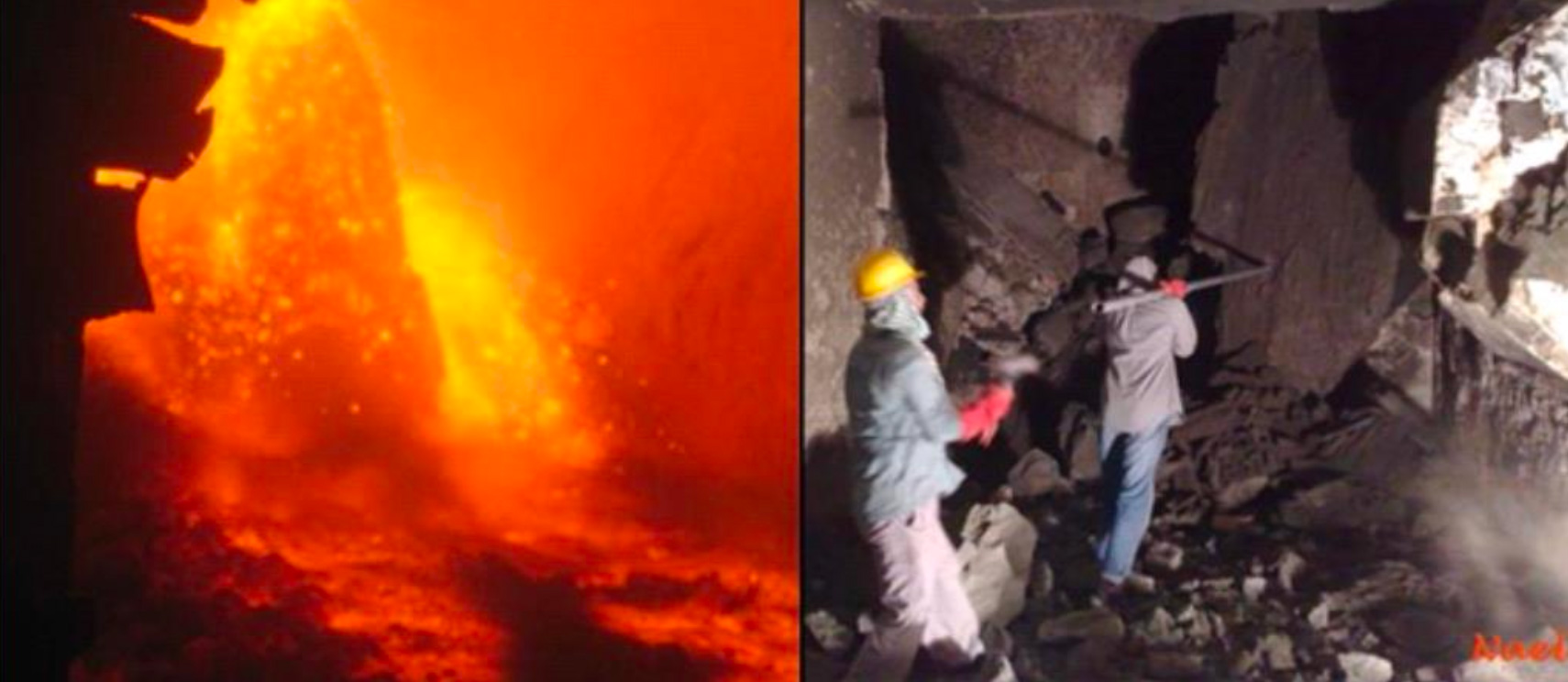
A poorly installed air cannon doesn’t just underperform — it can quietly drain compressed air, weaken equipment, and leave dangerous buildups in place. A single 50 scfm leak costs roughly $6.8k–$11k per year (at $0.26–$0.42 per 1,000 scf). Multiply that across a fleet and the penalty climbs toward hundreds of thousands per year. Plants often don’t realize the hidden cost of traditional cannon practices until efficiency drops or safety risks rise.
At Dracyon, we call this the Silent Million-Dollar Problem: every leak, misfire, and neglected cannon silently adds up to a major hit on plant reliability and profitability. And the root cause, more often than not, is installation and design mistakes.
That’s why we’ve developed a roadmap that covers common mistakes — and more importantly, how to avoid costly repercussions and unplanned downtime. Because the truth is: “It doesn’t matter how powerful your air cannon is if it is not working!” A plant full of cannons doesn’t guarantee results. If a cannon isn’t clearing buildup, it’s wasting air. Power and reliability are the foundation of an effective cleaning strategy.
Dracyon’s Solutions to Common Mistakes
Mistake #1: Too Small for the Job
The very first air cannons were designed to knock down cyclone and riser buildups without manual entry and to control sulfates and chlorides in kiln systems more safely for maintenance crews. Cleaning one meter ahead was considered groundbreaking.
Now, as cement plants scale up, cleaning systems must deliver higher mass flow and longer reach to match the increased volume and complexity of buildup.
Larger ducts, taller risers, and wider coolers demand more than peak pressure. They require sustained impulse and directional control to maintain performance across greater distances.
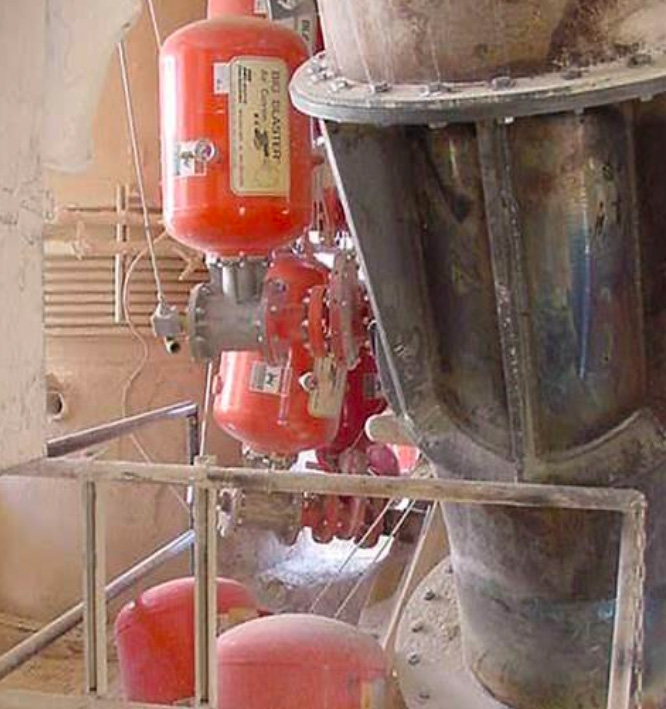
Above, 70 L cannons with only a 1-meter cleaning range are mounted on riser ducts more than 12 feet wide. The distance far exceeds their reach. To compensate, as many as 20 cannons are clustered around the duct, yet even with constant firing, they fail to control buildup. These small cannons simply cannot deliver the deep, powerful cleaning required.
When cannons are undersized, plants fall back to HPWW or Cardox, making shutdowns inevitable. This is so common that many plants consider it normal. What it really indicates is that the wrong type of cannon is being applied to extremely hot and difficult applications.
Opening an access door for HPWW creates two major problems. First, the shock of cold water on hot refractory shortens its service life and damages nozzles. Equally serious is the introduction of false air into the system.
To put this in perspective, a single 1-inch diameter hole in a tower can cost $50 per hour. An access door is 64 times larger, raising that cost to $3,200 per hour.
Because false air costs roughly $6,400 every shift, and HPWW is run 300 days per year, that adds up to about $3.84 million in wasted expense annually. Multiply that across shifts over a year and you’re looking at a $4,000,000 loss. This hidden drain is far larger than most plants realize.
The Dracyon Approach:
The 400 L Big Dog Multiplier (Fill-and-Fire), paired with Dracyon’s low-restriction Protector Valve and Alpha high-mass-flow nozzle, delivers the sustained impulse needed to move real material.
With a reach of approximately 7 meters, each Alpha nozzle covers more ground, allowing six remotely mounted nozzles to outperform a dozen legacy units. This isn’t about brute force — it’s about matching flow, duration, and angle to the deposit’s behavior.
By targeting buildup early — before it thickens, fuses, or disrupts airflow — the system maintains stable gas flow and minimizes false air. Emergency interventions decrease, operating costs drop, and plants shift from reactive cleaning to strategic control. High-pressure water washing is reduced by more than 90% and becomes a contingency rather than a routine.
Mistake #2: Heat Without Protection
“One, they hate the heat. Two, they hate material entering back into them.”
— Jeff Shelton, Dracyon Corporation
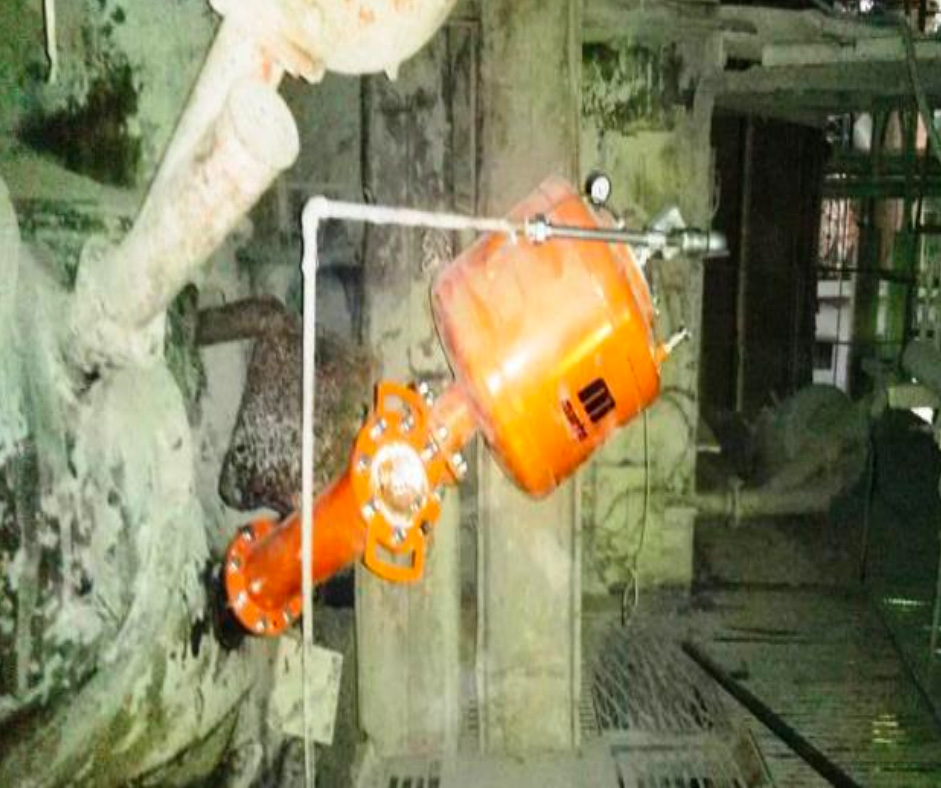
Cannons mounted directly in hot gas paths face brutal conditions. Steel tanks begin to weaken at 180°C, and inspections often reveal burned paint, blistered coatings, and tanks that lose pressure integrity. This shortens service life, creates nonproductive firings, and causes expensive air leaks.
Direct mounting forces cannons to fire into the gas stream and places them squarely in harm’s way. Heat accelerates wear and failure becomes routine. Instead of solving the problem, the design normalizes replacement.
The Dracyon Approach:
This type of installation is neither sustainable nor safe. Air cannons are investments that should protect plants for years, not months.
Dracyon protects cleaning force while extending service life through:
- Remote mounting with tanks and valves in protected locations
- Stainless braided hose routed to nozzles at the hot face
- Tees and bends to maintain direction while shielding equipment
- Protector Valves to prevent backflow and heat damage
- Water separators to prevent corrosion and nozzle fouling
The result is longer life, safer service, and full cleaning force.
Instead of disposable cannons, Dracyon builds systems for the long haul.
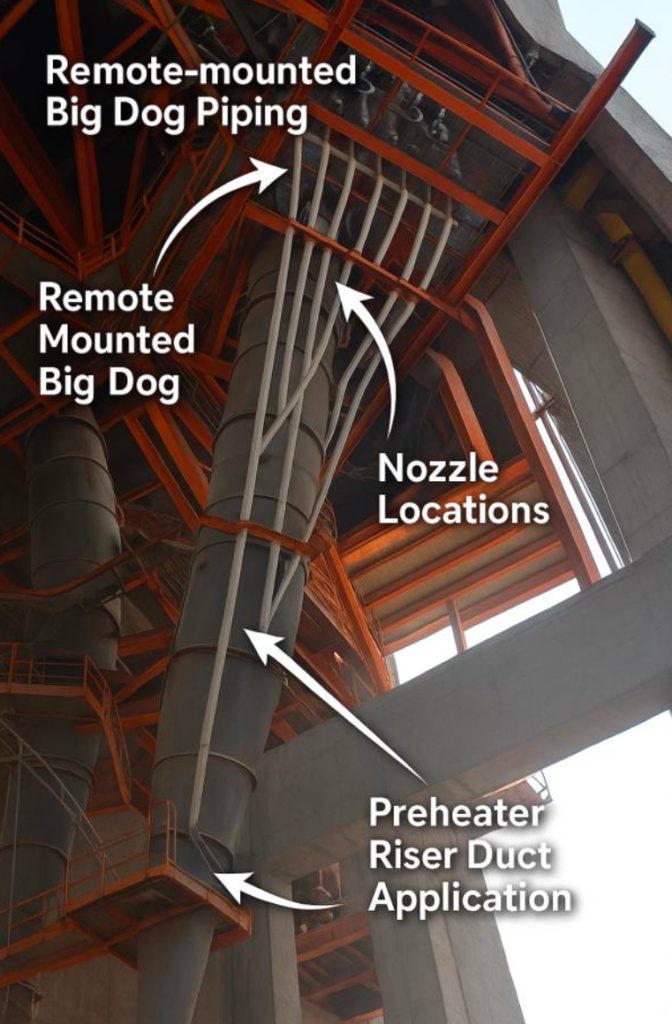
In this setup, Dracyon positioned six nozzles precisely where buildup forms, remotely mounted for direct impact. Air is routed through tees and bends to shield the supply line from heat, keeping the air cooler and denser for stronger blasting force. This configuration also prevents backflow from reaching the tank. The Protector Valve seals the tank 99% of the time, offering layered defense against heat, dust, and clinker intrusion.
Mistake #3: Leaks That Drain Profit
A constantly pressurized air cannon may seem convenient, but it’s a silent saboteur. Leakage through valves, fittings, or worn seals is not a matter of if, but when.
Annual compressed-air cost can be estimated as:
(leak scfm) × 525.6 × ($ per 1,000 scf)
Examples per cannon:
- 5 scfm → $700–$1,100/year
- 20 scfm → $2,700–$4,400/year
- 50 scfm → $6,800–$11,000/year
- 100 scfm → $13,600–$22,000/year
Clusters of small cannons can quietly bleed over $440,000 per year in wasted energy. Leaking units often remain in service, firing weak shots and dragging down the entire system.
The Dracyon Approach:
Larger tanks, Fill-and-Fire operation, and Protector Valves eliminate constant pressure on seals, dramatically reducing leaks while delivering stronger, fewer shots.
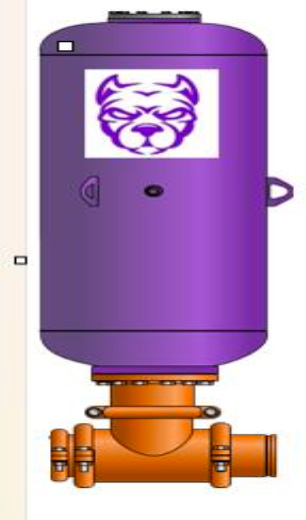
Dracyon’s Fill & Fire system uses zero air when idle and high-flow pulses on demand. Cannons with Protector Valves charge only during firing, eliminating constant pressure on seals and dramatically reducing leaks. Combined with our larger tanks, this design maximizes reliability while lowering air consumption.
By delivering longer and more sustained pressure wave into the buildup, one shot can clear what would take a machine-gun style firing of a smaller tank. This constant firing bleeds air from the plant’s system, while we reduce the total volume of compressed air used while improving cleaning power. It’s all about using air smarter.
Mistake #4: Unsafe Access and Hazards
Access isn’t convenient — it’s essential. If cannons are hard to reach, maintenance slips, safety exposure rises, and failures accelerate.
Common warning signs include:
- Cannons mounted in extreme heat zones requiring scaffolding
- Sequencing never updated because access is difficult
- Increased safety exposure from misfires or material spills
- Fallback to HPWW or Cardox due to neglected equipment
The Dracyon Approach:
Remote-mount cannons in cool, safe locations and route stainless hose to fixed high-temperature nozzles. Smart access enables proper maintenance, safer operation, and long-term reliability.
If you need a climbing harness to reach your cannon, the design missed the mark.
Mistake #5: Bad Aim. Weak Blast. Wasted Air.
What cleans isn’t plume width — it’s mass flow, on-wall velocity, and jet coherence at a shallow angle. Restrictive or fan-style tips choke flow and collapse reach.
Use high-mass-flow nozzles set at 10–25° incidence with proper stand-off distance. Aim with the gas flow. Use lasers and inclinometers to lock placement.
Red flags include:
- Polished hot spots with no cleaning path
- High firing frequency with little effect
- Nozzle or refractory damage opposite the target
- Rising compressor duty cycle
No nozzle can save bad aim or lack of power.
Mistake #6: Bad Sequencing and the Silent Million-Dollar Problem
Small cannons often chase universal firing cycles, leading to wasted air and weak shots. Frequent firing prevents pressure recovery, so every shot is weaker than the last.
Leaky cannons continue “ghost firing” while sequencers keep scheduling them, quietly draining headers and degrading performance.
With just 20 leaking cannons, annual losses can reach $300,000–$400,000 in air costs alone — not including lost production.
The Dracyon Approach:
Match force to deposit behavior using peak force to crack deposits and sustained impulse to shear and clear material. The Big Dog Multiplier with Alpha nozzles delivers both fracture and flow in a single, controlled system.
Final Thought
Air cannon mistakes are rarely isolated. One problem feeds the next. The only way to win is to design the entire system correctly from the start.
A cannon isn’t just a tank, a valve, or a nozzle. It’s a system. And only when every part works together — cool, sealed, and properly aimed — do you get true cleaning performance.
Design smarter. Fire cleaner. Save millions.