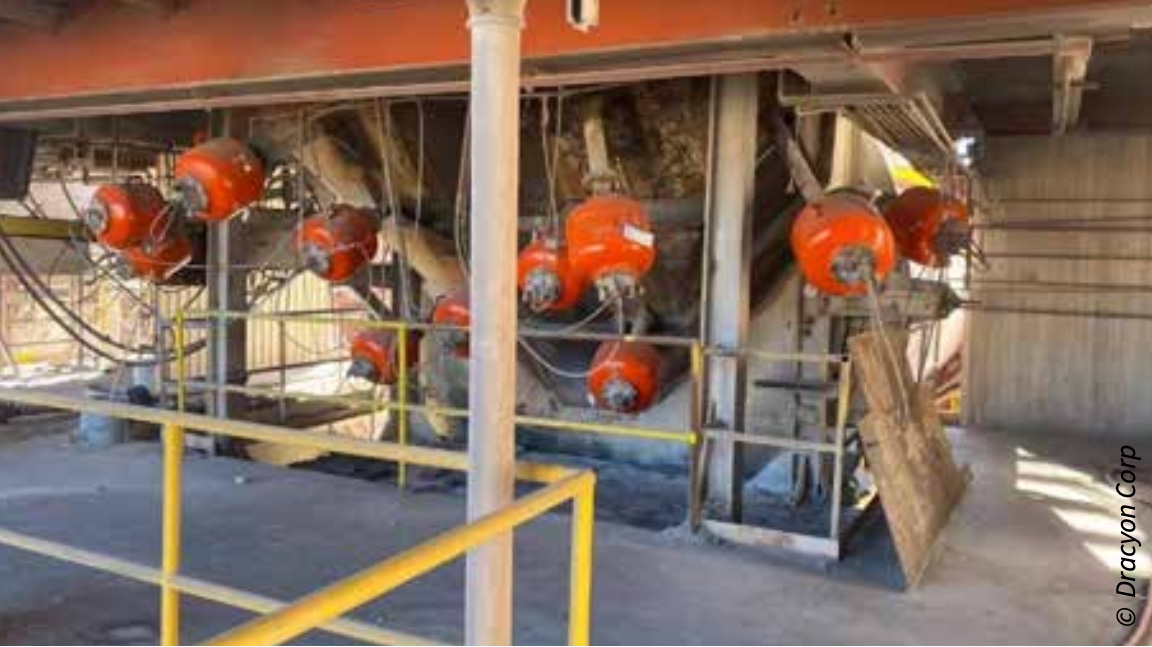
An air cannon is a simple device that stores air in an air tank before allowing it to quickly escape into a nozzle via a proportionally large valve. The quicker the valve opens, the less restriction (pressure drop) there is in the air cannon. The less pressure drop (ie the higher the pressure), the greater the peak force.
The air cannon’s blast is shaped by the nozzle, which can also be used to convert energy from one form to another, without loss of energy (cf Newton’s Law of Energy Conservation). Therefore, a high-velocity nozzle converts pressure into a higher velocity. This velocity increase is designed to improve the impact of the air blast on build-up, moving the material from an unwanted location. Success in moving the material is determined by the power of the blast and its duration.
Air cannons: issues and limits
To help maintain the highest possible pressure of the air blast and ensure sufficient blasting power, air cannon OEMs have focussed on important design issues. It has been presented by some air cannon OEMs that the key to success with an air cannon is the highest peak force possible. Therefore, in Europe, some plants have employed dedicated air compressor systems in air cannons and increased pressure to 10bar or 150psi, resulting in a significantly higher cost in terms of compressed air requirements than a typical 8bar system.
High usage of air limits air pressure
An additional factor impacting the power of the blast is that the air usage of air cannons is so great that it has limited the available air pressure. For example, an air compressor system designed to produce 100psi is only able to supply 60psi. This low pressure will impact the cleaning performance of any air cannon system and the efficiency of plant operation. Furthermore, this could lead to failure of other pneumatic equipment and decreases the air compressor reliability because, in this case, it is required to run 100 per cent of the time. Air usage that demands the air compressor to run at 100 per cent capacity is unacceptable.
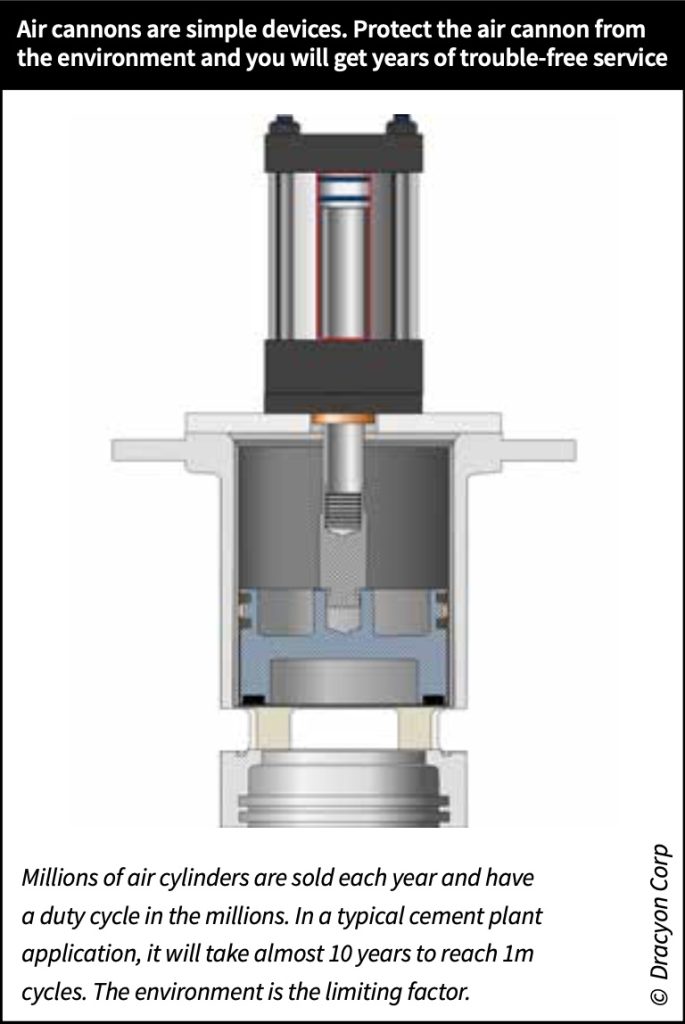
Air leakage
Moreover, in most cases this increased air load is not due to the air discharged by the air cannon during normal operation, but by leaking air cannons. Air cannons that store air in their tanks have leaks. If a small, 5scfm leak per air cannon is assumed, then often for an air cannon system, the greatest source of air consumption is down to leakage, which the operator is unable to hear. For example, in a conventional 100l air tank, operating at 8bar, air leakage can be as high as 550scfm, resulting in 15,570.50l/min. This represents an estimated cost of US$207,900/year.
While Dracyon air cannons, such as its Big Blue Air Cannon, also leak, they avoid high air usage as they do not store air in their tank. Their tanks are filled with air, which is then immediately discharged.
This system is also safer for workers, who are protected from the many hazards that come with storing air.
Optimising blasting power
Traditional key design features To optimise the power of the blast (and thus ensure the highest peak force), many air cannon OEMs focus on two design features:
- Direct exit path for compressed air – A reduction in the number of turns and bends will reduce pressure drop and allow greater peak force. This is why many air cannon OEMs favour internal air cannon designs. The fact that the valve assembly is inside the air tank does allow a design that eliminates several of the bends and turns, leading to a reduction of the pressure drop. The result being an air cannon with a greater peak force.
- Faster opening valve – The quicker the valve opens, the higher the peak force is. The quick-opening valve reduces pressure drop and makes the air cannon stronger for that instantaneous blast.
Dracyon Corp agrees with both statements, but does not agree that a stronger initial blast necessarily equals better cleaning.
It also thinks moving the piston faster will result in a more violent stop and cause quicker failures, leading to greater maintenance requirements.
From power to performance
The role of kinetic energy, volume
and velocity
The key to cleaning with an air cannon is for the blast from the air cannon to be strong enough to overcome the mechanical strength of the build-up. The longer a greater force is maintained than the force holding the build-up, the more cleaning will occur. Moreover, the greater the difference between the air blast and build-up forces, the sharper the clean. The closer the air blast is to the mechanical force that holds the material together, the more likely it is that the material will be removed in lumps.
Dracyon believes that the key to cleaning is a powerful blast from the air cannon, even at a lower peak force, over a sufficient time to break down the mechanical forces that hold the build-up in place.
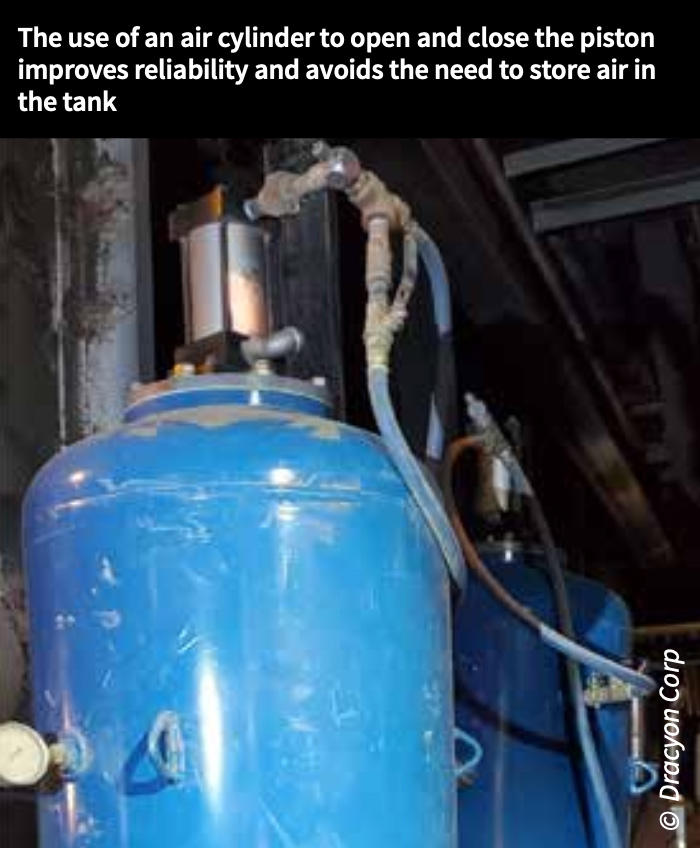
The air stored inside the air tank is the cleaning energy used. If you compare a 70l air tank pressurised at 1bar, there is 70l of compressed air in the air tank. This stored air is now potential energy. This air becomes kinetic energy when the sealing valve is opened and the flow of air starts. Dracyon believes that kinetic energy is a more valuable gauge of cleaning energy than peak force.
The formula for kinetic energy (KE) is:
KE= ½ m v2
where: m = mass
v = velocity.
This formula shows that both mass and velocity are important. In the material test that compares the removal performance of 70l vs 300l air cannon models, the larger, 300l volume (ie, mass) is over four times greater. This increased volume enables a greater energy discharge (ie, power of the blast) and a longer blast time during the cleaning process.
Therefore, while peak force plays a key role in cleaning, air volume is also a major factor. For example, in a plant with 100 air cannons, it is incorrect to assume that 70l air cannons use four times less air to clean the process. The 300l air cannon, thanks to its greater volume, can exert greater forces and does not need to be cycled as frequently.
Benefits of dual firing
A second factor that must be considered is to understand that when the exiting air blast from the air cannon strikes the build-up there is an equal and opposite reaction. The energy from the air blast is transferred into the build-up and this build-up flies away. As the buildup flies away so does the cleaning energy. The second blast occurs after the cleaning has been completed from the first blast. The cleaning is expanded because the initial collision occurs further away. A double blast can increase the cleaning area between 40-100 per cent.
Increasing air cannon reliability
To improve air cannon reliability, Dracyon has developed its Big Blue Air Cannon system. The product range includes the benefits that reduce, if not eliminate, some of the issues presented by air cannons:
- Lower operational compressed air cost. Filling and firing your air cannon immediately eliminates the amount of time available for air to leak. Moreover, it also eliminates at least 96 per cent of the time an air cannon will be left charged, and therefore a potential hazard to the workforce.
- Greater power from each air cannon allows a decrease in the operational cycle of the air cannons. It is estimated that a 300l system will clean better than a 70l system if it is operated with a duty cycle 25 per cent less than a 70l system. The less the system is discharged, the less maintenance is required.
- Dual firing air cannons can reduce the number of air cannons in a cement plant. One air cannon replacing two is a positive move.
In summary, well-designed, reliable air cannons can not only deliver great cleaning performance, they can also reduce some of the issues associated with them, including high usage of costly
compressed air. Dracyon believes that air cannons that store their air in a tank prior to blasting waste compressed air through extensive leaking, resulting in high avoidable cost